
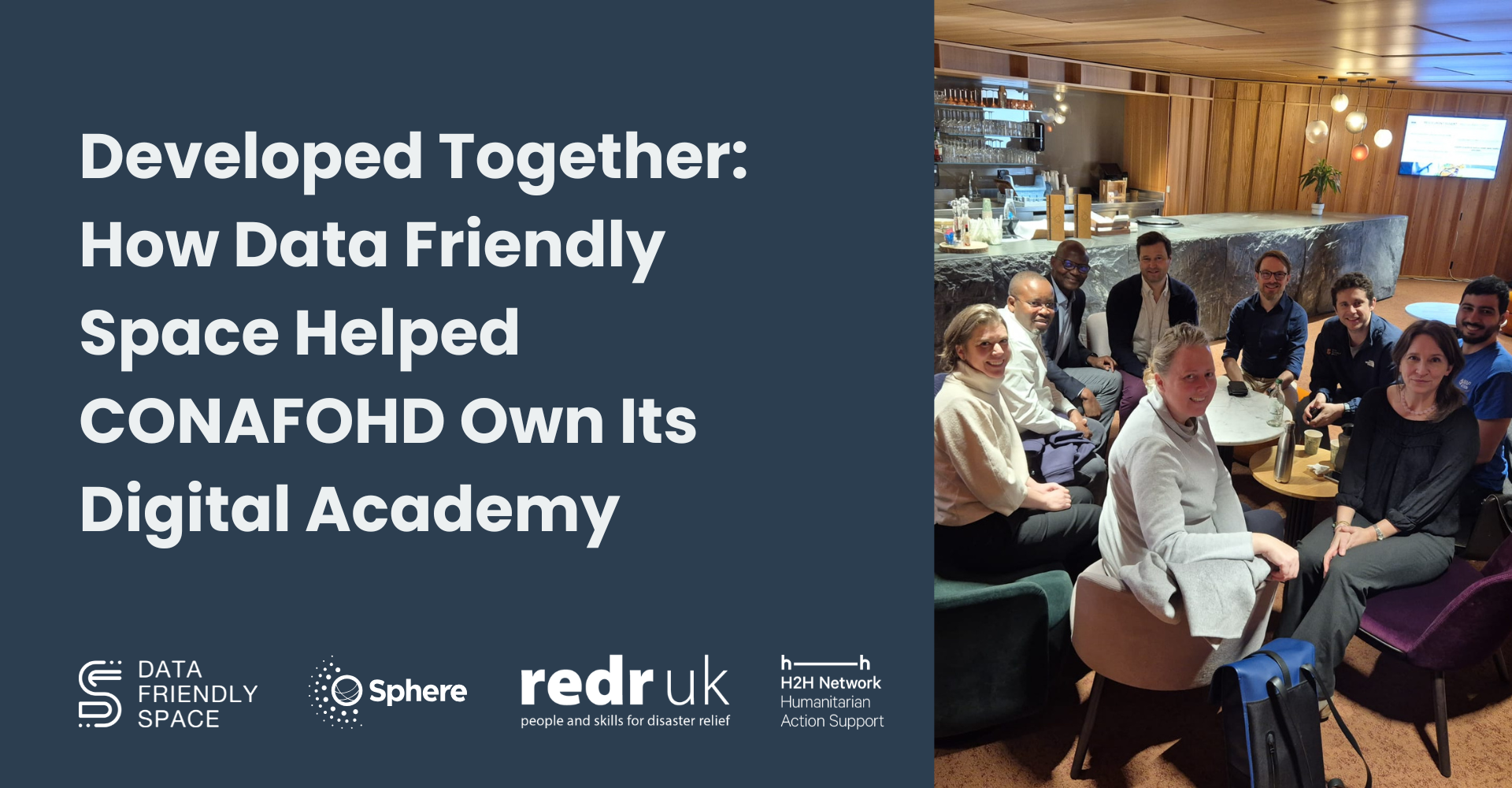
It is common in the field of humanitarian technology to develop tools and hand them over, only to find they go unused once the project is over. The case of KOLAcademy, a new digital learning platform for the Congolese NGO network CONAFOHD, is an obvious attempt to prevent such a situation.
The KOLAcademy platform was developed by a consortium of Data Friendly Space, RedR UK, and Sphere as part of a project supported by the H2H Fund and in association with CONAFOHD; the platform was not only designed for CONAFOHD but was created together with them at each stage, always keeping in mind what would occur after the project had ended.
KOLAcademy is essentially a fully featured learning management system (LMS), offering facilities for hosting and uploading courses, tracking progress and tests, managing user enrolments, and providing a content management system that enables CONAFOHD administrators to manage both users and materials without relying on external technical support.
This kind of thing needed a cooperative effort. Because KOLAcademy had to operate smoothly alongside CONAFOHD's KOLData system, DFS worked closely with CartONG, the organization responsible for managing KOLData's infrastructure. The two teams completed the single sign-on integration, set up the subdomains, and provided hosting recommendations. These steps are essential for ensuring that the platform functions reliably every day. In practice, this means users can switch between the two systems with the same login, and any certifications obtained in KOLAcademy will be linked to their CONAFOHD NGO profiles. As a result, learning becomes a credible and transferable qualification within a trusted system.
Two features make KOLAcademy special and directly address the challenges of working in the Democratic Republic of Congo. The first of these is an offline mode, which allows learners to download courses and continue with them even without an active internet connection; a vital feature, since internet connectivity is so uneven in rural and remote parts of the country. The second feature is an AI-powered chatbot that provides conversational learning support within the courses.
Language was treated with similar care. The consortium put translation efforts where they mattered most for learners: all course content, descriptions, and learning materials are available in French, Lingala, and Congo-Swahili and are uploaded to the platform. This shows a user-centered approach, focusing resources on accessibility that truly helps people learn, rather than translating interface elements.
KOLAcademy was intended to be more than just a tool for a single organization and has since become a shared public resource, providing learning materials from other members of the H2H Network and going beyond the original consortium's offerings. This enables the member organizations of CONAFOHD to access an ever-growing collection of high-quality training in one place and to add their own courses from their networks.
As DFS’s Head of Product Solutions, Álvaro José Guerrero Torres stated,
“Combining top-notch technology with community impact is what drives us. This learning platform is a strong example of DFS' mission in action.”
It's tempting in humanitarian tech projects to measure success purely by features shipped or users onboarded. KOLAcademy's real achievement may be less visible than its offline mode or its chatbot: it's the fact that CONAFOHD has full ownership of the entire platform.
For other national networks composed of NGOs facing similar gaps in their digital capabilities, the KOLAcademy experience provides a useful example. Rather than having a platform imposed on them from outside, it was developed together, translated in the places where it mattered, and was handed over along with the tools needed to keep it going.


